AI-generated scenes have moved well beyond novelty. They now sit inside real advertising workflows, shaping everything from concept films and product worlds to campaign variations and synthetic b-roll. But a scene that looks impressive in isolation can still fail in production through drifting identities, broken physics, inconsistent lighting, inaccurate products, or edits that simply do not cut together. This guide looks past the hype and into the mechanics: how AI-generated scenes are planned, controlled, composited, and quality-checked for brand use. The goal is to understand where generation ends and human craft begins.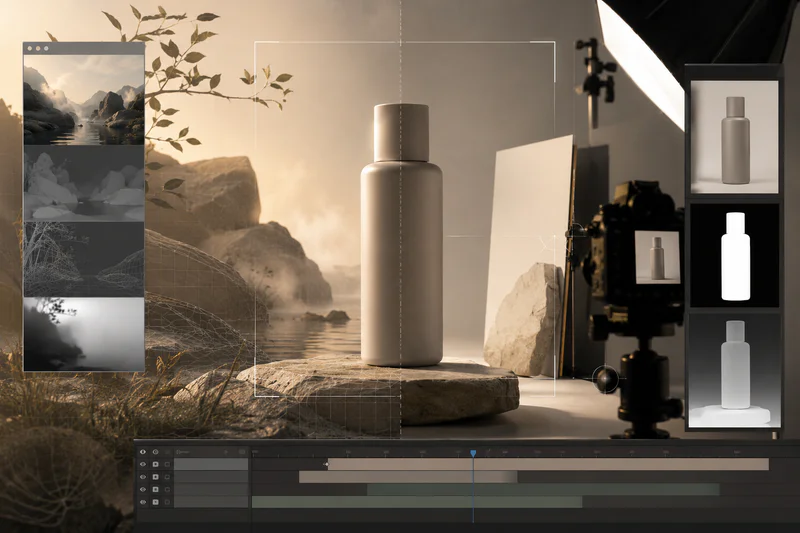
What Are AI-Generated Scenes?
AI-generated scenes are visual environments, actions, or moments created partly or entirely with generative models. They may begin with a text prompt, a reference image, existing footage, product photography, or a combination of all four. The result can be a complete synthetic shot such as a car moving through an impossible landscape, or a single generated layer added to conventional production with a new background, weather effect, set extension, or transition.
An AI-generated scene is not necessarily an AI-generated advertisement. In professional workflows, generation is often one component within a larger production system involving art direction, cinematography, compositing, editing, sound design, and colour grading. The useful question, then, is which parts were generated, which parts were captured, and how those choices support the product and its story.
Why Good-Looking AI Generated Scenes Often Fail in the Edit
An AI-generated shot can look convincing on its own and still become unusable the moment it is placed beside another. Advertising rarely depends on a single beautiful frame. It depends on continuity: the product must retain its shape, the character must remain recognisable, the light must come from the same direction, and the action must progress logically across cuts.
This is where generated scenes often break under editorial pressure. A jacket may change texture between a wide shot and a close-up. A bottle may become slightly taller, its label may shift, or its reflections may stop matching the environment. Eye-lines, camera height, screen direction, and emotional performance can also differ from one clip to the next, making the sequence feel assembled rather than directed.
The problem is related to both inconsistency in appearance and in the scene’s internal logic. Traditional video production records one physical world from multiple angles. Generative models create each shot as a new prediction, unless identity, environment, lighting, and composition are actively constrained. For brand production, the true measure of an AI generated scene then becomes if it can survive a cut, preserve the product, and remain coherent as part of a sequence.
Causal Density: Why Some Scenes Are Harder to Generate
Causal density refers to the number of relationships a generated scene must preserve while an action develops. These relationships may involve object identity, geometry, contact, motion, material behaviour, spatial position, lighting, and changes of state. The term is production shorthand rather than a standard benchmark used by the professionals.
For example, a scene of a bottle standing in mist has relatively few dependencies. The mist can vary between frames without changing the meaning of the shot. However, a scene of the same bottle being picked up, opened, tilted, and poured is more constrained. The bottle must remain the same size and shape while it rotates. The hand must maintain credible contact. The cap must follow the thread of the neck. The liquid must respond to the changing angle, and the printed label must remain attached to the curved surface throughout the movement.
Current video generators typically produce frames by denoising a learned latent representation conditioned by text, images, or other controls. Architectures use temporal layers or space-time attention to share information across frames, but this does not automatically create an explicit 3D scene model, a physics simulation, or a persistent record of every object and its state. The system is generating a statistically plausible video, while the production requires several exact constraints to remain simultaneously true.
The difficulty grows when the video asks for several bound relationships at once: which hand holds which object, where contact occurs, what changes during the action, and what must remain unchanged. Temporal compositionality evaluations show that models can produce convincing frames while failing to complete the transition described between an initial and final state. In other words, individual frames may look plausible, but the video may not correctly show the intended change unfolding over time. TC-Bench, published in 2024, found that contemporary video generators achieved less than 20% of the compositional changes evaluated, meaning they generally failed to fully depict the requested progression from an initial scene state to a final one.
For advertising, causal density becomes especially important as it carries product information. For example, a cap opening incorrectly, a logo sliding across a package, or a liquid behaving unlike the real formulation can alter the claim being made. Those shots often need narrower actions, stronger reference controls, separately generated plates, or real product footage integrated into a hybrid scene.
Four Technical Failure Points in AI-Generated Scenes
Temporal coherence
Temporal coherence concerns stability within a single shot. Faces, clothing, product details, reflections, or small features may drift as the clip progresses, especially during rotation, movement, or occlusion. An AI generated scene can feel smooth while still changing in ways that make it unusable.
Inter-shot continuity
Inter-shot continuity concerns consistency across separate video clips in AI generated scenes. A character may look slightly different between a wide shot and a close-up, while product scale, lighting direction, lens perspective, wardrobe, or set details may shift between cuts. Reference systems reduce this variation, but generated coverage often still needs selective cleanup or compositing.
State transitions
State transitions in an AI generated scene involve a visible change, such as opening packaging, slicing food, applying a product, or moving through an interface. Models may produce convincing start and end states without generating a believable process between them. Shorter actions, controlled keyframes, or practical capture can reduce this risk.
Semantic and product accuracy
An AI generated scene may look plausible while communicating incorrect information. Labels can distort, dimensions can shift, materials can change, and mechanical behaviour may be invented. Reference images improve resemblance, but precise logos, typography, interfaces, and product features are often retained from real assets or rebuilt in post-production.
These failures matter differently depending on the shot. Atmospheric elements can tolerate some variation. Product demonstrations, claims, and close-up brand assets require much tighter control.
Why Prompting Alone Is Not Production Control for AI Generated Scenes
A prompt tells the model what kinds of visual features should become more probable during generation. It does not function like a technical drawing, a lighting plot, or a set of coordinates that the system must execute exactly. For advertisers, the consequence of this is straightforward because most prompts are under-specified. And these specifics are filled by the chosen AI model from patterns learned during training. The result may satisfy the prompt in the literal sense while departing from the production team’s unstated expectations.
Adding more descriptive language can narrow the range of outputs, although prompt detail does not often translate cleanly into independent control. Attributes are often entangled like changing the camera angle may alter the face or asking for stronger movement may affect wardrobe or product geometry. Some instructions receive less influence because of token weighting, prompt length, conflicts between conditions, or the model’s stronger learned priors. Small changes can lead to substantially different compositions. Model updates may also change how an identical prompt is interpreted.
Production control therefore requires constraints outside the text prompt. Reference images can anchor subject identity and product appearance. Masks can restrict changes to selected areas. Pose, depth, edge, or motion guidance can preserve composition. Start frames and end frames can narrow a transition. Locked model versions, recorded parameters, and shot-specific reference packages make results easier to reproduce. But even these controls have limits. A reference image may preserve the front of a package while allowing its unseen side to be invented. Pose guidance can hold the body’s structure without protecting facial identity. A depth map can stabilize spatial arrangement while leaving materials and branding free to drift.
For companies looking at AI for advertising, prompting is best understood as one layer in a control system. The rest comes from reference design, generation settings, continuity management, compositing, conventional graphics, and frame-level quality review.
How Hybrid AI Production Creates Control in Practice
Hybrid production begins by deciding which elements of a shot can tolerate interpretation and which must remain exact. A background skyline may be safely generated. A hero product, readable label, specific hand interaction, or regulated claim may need to come from photography, live action, 3D, or conventional graphics. This decision is made before generation, because attempting to recover product accuracy after the scene has been built around an incorrect object is usually inefficient.
The shot is then divided into controllable layers. A real product plate might be captured against a clean background, with matching lens information and lighting references. The generated environment is created separately, often with enough negative space and camera stability to support compositing. Additional passes may be produced for atmosphere, reflections, shadows, set extensions, or transition elements. Separating these components allows the team to replace a weak layer without regenerating the entire shot.
Camera logic matters throughout this process. Perspective, horizon height, focal-length character, depth of field, motion blur, and camera movement must agree across captured and generated material. A product filmed with a long lens will feel pasted into an environment whose perspective resembles a wide-angle shot, even when the composite is technically clean. Lighting presents the same problem: direction, softness, colour temperature, contact shadows, and specular highlights must describe the same imagined source.
Editorial decisions are usually made before extensive cleanup. Teams test whether the shot communicates quickly, matches the surrounding coverage, and survives the intended cut. There is little value in repairing every frame of a clip that will later be shortened, reframed, or removed. Once the edit is stable, compositors can address edge contamination, geometry drift, inconsistent reflections, occlusion errors, and unwanted changes in product detail.
Typography, logos, interfaces, disclaimers, and other precision elements are commonly rebuilt rather than generated. These assets need predictable placement and frame-to-frame stability, particularly when the advertisement will be adapted across aspect ratios or languages. The final review happens at sequence level. A frame can be attractive while introducing a continuity error that becomes obvious only during playback. Product scale, screen direction, movement speed, colour response, grain, sharpness, and sound all influence whether generated and captured material feel as though they belong to the same production.
Hybrid workflows do not remove generative uncertainty. They contain it. The production team chooses where the model is allowed to invent and where the scene must remain accountable to a reference.
When to Generate, Composite, or Shoot Practically
For many brand campaigns, AI-led hybrid offers the most useful balance. It allows the generated material to determine the scale, setting, and visual language of the scene, while practical assets and conventional post-production preserve the details the audience is expected to trust.
The decision still depends on the consequence of error. A changing cloud formation may be inconsequential. A drifting label, inaccurate fit, or physically impossible product demonstration can misrepresent what is being sold. AI-led hybrid works best when the production team identifies that boundary before generation begins.
Conclusion
AI-generated scenes are becoming a serious production medium, but their value depends on how deliberately they are used. The strongest results come from understanding where models can invent freely and where the image must remain accountable to a real product, action, or claim.
For many advertising briefs, an AI-led hybrid workflow offers the best balance. It gives creative teams greater speed, scale, and visual range while preserving control through reference assets, compositing, practical capture, and human review. The question is no longer whether AI belongs in production. It is how carefully the production is designed around what the scene needs to prove.
Also read,
Why AI Ads Fail: The Story Logic Problem Behind Poor Performance | Personate
The Real Cost Of Running AI Ad Production In-House | Personate
How and Why Did Personate Become an AI Ad Agency in 2026 | Personate