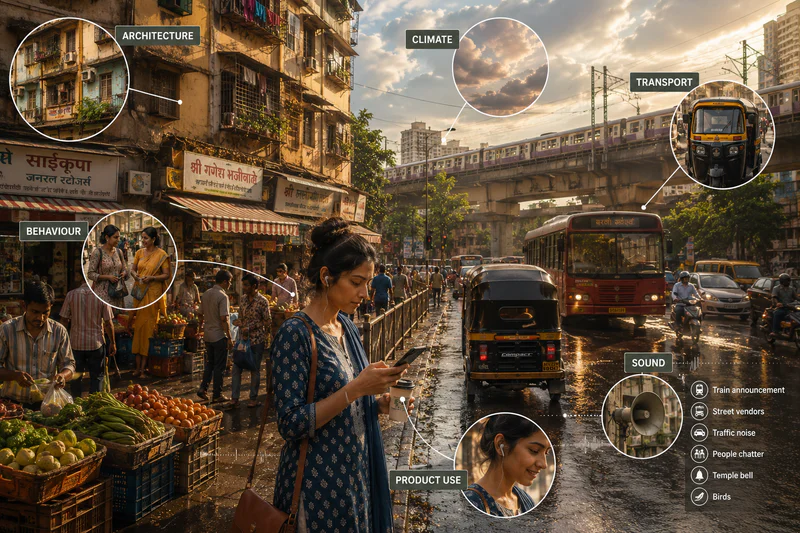
A luxury apartment ad set in a random glass tower. A food delivery ad on a street no local buyer recognises. A family banking ad inside a home that feels imported. This is where weak AI creative starts to lose trust. Location diversity in AI advertising helps brands avoid that generic sameness by using places, climate, streets, homes, shops, and neighbourhood cues people instinctively recognise. As brands scale AI ad creative for multiple markets, location of the advertisement deserves sharper creative planning. In this article, we will cover why location diversity matters, how it affects audience response, and how brands can use it effectively.
What Is Location Diversity In AI Advertising?
Location diversity in AI advertising refers to the planned use of varied geographic settings, local environments, architectural styles, climate conditions, public spaces, and neighbourhood characteristics within creative assets. It helps brands avoid generic backdrops and build stronger AI creative location relevance.
In practice, geographic diversity in AI-generated ads can include distinct streetscapes, local retail spaces, housing styles, transport systems, weather conditions, regional landscapes, and community settings. These AI advertising location cues influence how audiences read an advertisement. A campaign may carry the same product, offer, and brand identity across markets, yet the setting can change how familiar, credible, or distant the message feels.
Many generative AI tools default to a narrow visual range. Modern offices, polished cafés, neutral homes, and anonymous city streets appear repeatedly. The result is professional-looking creative with weak regional visual cues in advertising. For marketing teams, this creates a missed opportunity. Location-specific AI ad creative can make an ad feel closer to the buyer’s world without changing the entire campaign idea.
Why Generic Locations Create Generic Advertising
Most discussions about advertising focus on messaging, targeting, and creative execution. The place rarely receives the same attention. That is surprising because people are exceptionally sensitive to environmental context. A person that struggles to recall a headline they saw yesterday is the same person who can instantly recognise when a street, neighbourhood, transport system, or public space feels familiar. People process environments long before they process marketing messages. The counterintuitive insight here is that audiences often notice when a location feels wrong long before they notice when a location feels right. Good location diversity rarely draws attention to itself. It simply removes a layer of friction between the creative and the audience.
This creates an overlooked challenge in location diversity in AI advertising. Many brands believe that stripping a campaign of strong visual cues makes it more widely relatable, yet this same neutrality can also make it feel less meaningful or harder to connect with. When a location feels disconnected from a viewer's reality, the creative asset loses specificity. It becomes harder for audiences to picture themselves within the story being presented. The effect is subtle because viewers rarely articulate it. Few people say, "I ignored this ad because the streetscape felt unfamiliar." Instead, the advertisement simply feels less memorable and less connected to everyday life.
For regional marketing teams, the challenge becomes even greater. Many AI-generated video ads rely on a surprisingly narrow range of visual references. As a result, different campaigns begin to share the same environments, even when targeting entirely different audiences. This weakens AI creative location relevance and contributes to a growing sense of sameness across categories.
How Location Cues Shape Trust, Recognition and Product Desire
A location can look accurate on the surface and still feel wrong to the viewer. An AI-generated Mumbai banking advert may include autos, monsoon rain, local Marathi signage and yet the pavement may feel strangely empty. Viewers may never identify each fault, but they register the combined improbability. Location diversity in AI advertising works when geography, human behaviour, cinematography, sound and product use support the same commercial truth.
Location Diversity Changes How Concretely People Process An Offer
Psychological distance helps explain why location can be persuasive in marketing. When a place or situation feels distant, people tend to interpret it in broader, more abstract terms. When it feels familiar, they can more easily imagine the practical details: how the product would be used, who would use it, and where it would fit into everyday life. This shift is a movement from “abstract evaluation to concrete interest”. This makes location diversity in AI ad creative more than a visual choice.
For marketers, this changes the job assigned to AI advertising location cues. A familiar street can help someone mentally simulate the product experience. A commuter who recognises the station layout can imagine the journey. A renter who recognises the housing type can picture the property offer. A shopper who recognises the retail setting can estimate convenience. Well-planned location-specific AI ad creative turns a remote claim into a situation the viewer can mentally rehearse.
Viewers Detect Broken Local Logic Before They Explain It
Decision makers often assess a regional advert through obvious location markers. Does the scene contain the right skyline, vehicle, clothing or script? Audiences judge a denser system. They absorb street width, pedestrian movement, weather, light direction, personal space, traffic behaviour and commercial clutter together. One minor incorrect detail may at times pass unnoticed. Several small contradictions can make the entire scene feel fabricated, weakening AI creative location relevance before the product claim has received fair attention.
It is because people carry learned expectations about how familiar places operate. When a scene violates those expectations, the viewer must spend more mental effort interpreting it. Trust then weakens through small contradictions, not one dramatic cultural mistake. That is why regional visual cues in advertising should be judged as a connected system, rather than a checklist of local symbols. Here the most counterintuitive production lesson is that geographic diversity in AI-generated ads may need fewer iconic symbols and more ordinary accuracy.
Camera Placement Determines Whether The Brand Feels Present
Camera grammar carries a point of view. Aerial shots, symmetrical compositions and immaculate wide frames can make a city look desirable. They can also position the audience as spectators. Eye-level framing, partial obstruction and motivated handheld movement place viewers closer to the physical experience. Depth of field also affects AI creative location relevance. The correct choice depends on the category, but every multi-market AI advertising strategy should consider whether the camera observes the location from outside or participates in it because these details give market-specific AI advertising a credible physical basis.
Performance Direction Carries More Local Truth Than Casting
Local casting alone does not make an advert feel local. For culturally relevant AI advertising, casting decisions should include behavioural direction, not appearance alone. This is often missed because casting photographs are approved before movement is considered. The creative team confirms age, wardrobe and appearance, then relies on generic commercial gestures. The result is a locally cast person smiling, pointing and presenting a product like actors in every other market. The face changes, while the behavioural code remains global.
That is why Creative Directors working on AI ad creative for multiple markets should add behavioural notes to every shot. How quickly does the character move? Who starts the interaction? Where does the person look before using the product? What would normally occupy the other hand? These details sound minor during planning. On screen, they decide whether the performance feels observed or invented.
Product Placement Should Follow Local Usage Logic
Location earns its production budget when it changes how the product benefit is understood. Heat can increase the sensory appeal of a drink. A crowded commute can demonstrate noise cancellation. A compact kitchen can make storage efficiency persuasive. An unreliable connection can give an offline feature commercial relevance. Strong location-based ad creative gives the product a believable problem to solve. Weak product placement reverses this logic. When an actor opens a snack packet with the logo held perfectly flat to the camera, even though their attention is on the conversation, it makes the brand gain screen visibility while losing credibility. The core product may stay consistent across markets. Its place within daily life can differ sharply. Location diversity for AI ads should make those differences visible without turning the setting into decorative regional theatre.
Sound Can Expose A False Location Immediately
Sound teams often receive less attention than image production, yet sound carries dense geographic information. Room reverberation suggests materials and dimensions. Traffic noise reveals road design. Public announcements reveal language, rhythm and infrastructure. Fans, vendors, birds, shutters and crossing signals build local environment cues in advertising that audiences may recognise without conscious effort. This problem becomes more obvious through headphones, where individual layers sit closer to the listener.
Generic sound libraries flatten differences. A track labelled “busy Asian street” may contain vehicles, voices and warning sounds from several countries into one vague atmosphere. As a result, even when the video asset appears accurate, the soundtrack creates contradictions. Dialogue needs the same discipline. Local credibility depends on interruption, emphasis, sentence length, politeness and humour. Accent matching covers only one part of the task. A translated line may preserve meaning while sounding unlike anything a person would say in that setting. AI creative localisation needs speech direction, rhythm and social context, not word replacement alone.
How Brands Can Plan Location Diversity In AI Ad Creative
Strong location diversity in AI advertising needs a clear planning system. Without one, teams create regional details that look local but do not improve product understanding or campaign learning.
Step 1: Lock The Campaign Core
Keep these elements consistent across markets:
Product promise
Brand codes
Offer structure
Legal claims
Pack treatment
Final call to action
This protects AI ad creative for multiple markets from becoming fragmented.
Step 2: Identify The Location Variables
Decide what can change by market:
Climate
Housing style
Transport behaviour
Retail setting
Public spaces
Dialogue rhythm
Soundscape
Product usage
Each variable should change how the audience understands the product. If it only makes the ad look regional, it is weak localisation.
Step 3: Build A Market Cue Map
Create a cue map for each priority region.
Include:
What the place looks like
How people move through it
Where the product naturally appears
Which details would make the scene false
This improves AI advertising location cues and reduces generic AI output.
Step 4: Write The Scene Before Generating It
Do not prompt AI with “make this local” too early.
First decide:
What is happening in the scene?
Why does the product enter that moment?
Where should the camera sit?
What should the viewer notice?
What sound makes the place believable?
This keeps location-specific AI ad creative from becoming a background swap.
Step 5: Generate Scenes, Not Templates
A useful regional variant should have:
Setting logic
Actor behaviour
Product placement
Sound cues
Local copy detail
These make geographic diversity in AI-generated ads commercially useful.
Step 6: Measure Behaviour After Launch
Internal approval does not prove that the location worked.
Track:
Watch time
Completion rate
Click behaviour
Cost per result
Conversion
Regional comments
The best location diversity in AI ad creative changes how people notice, trust, understand, or act on the offer.
How A Hybrid AI Ad Agency Helps Scale Location Diversity
Planning location diversity in AI advertising takes more than prompt writing. AI can generate the frame, but it does not always know whether a place feels lived in, whether the product use is believable, or whether the behaviour fits the market. This is where Personate’s hybrid AI ad agency model fits naturally. AI accelerates the production layer, while human specialists decide which location cues deserve attention and which choices may create cultural or performance risk. Personate’s 72-hour promise gives brands a faster path from brief to market-ready creative.
Have one strong campaign idea, but need it to work across different markets? Email us at hello@personate.ai, or you can get in touch using this form or bybooking a call.
Also read,
The Real Cost Of Running AI Ad Production In-House | Personate
How and Why Did Personate Become an AI Ad Agency in 2026 | Personate
Brand Video Production in 72 Hours: Inside Personate’s 6‑Step Process | Personate