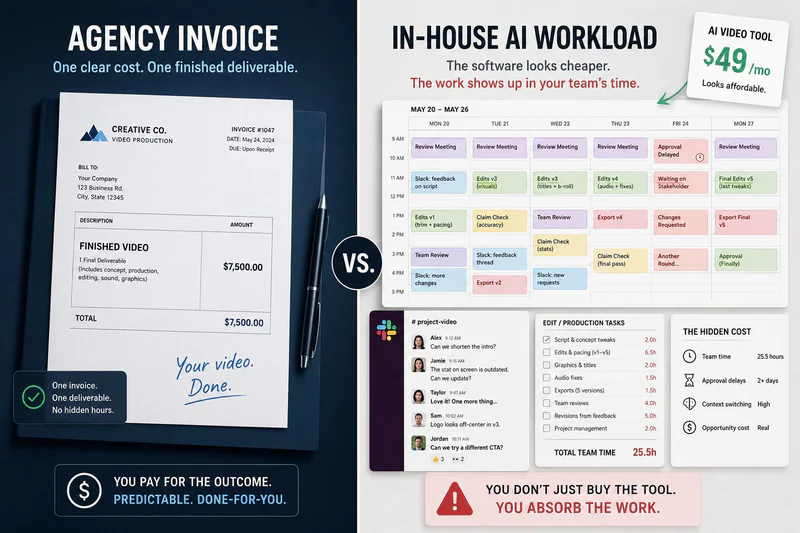
Most teams consider in-house AI ad production because agency pricing can feel expensive when every new video, ad, edit, or variation adds cost. AI tools seem to offer a cheaper, faster way to produce more creative assets. But replacing per-ad agency fees with software does not make production free. It shifts work into your team’s calendar. In this article, we will cover the real cost of running AI ad production in-house, including software, labour, review cycles, delays, and hidden coordination work.
Why Teams Start Looking At In-House AI Production
Teams usually look at in-house AI ad production when agency costs start to limit the return they can get from creative testing.
Paid media performance depends on variation: new hooks, cutdowns, audience-specific versions, product-led edits, founder-led edits, platform formats, and fast refreshes when ads fatigue. If every new variation adds another agency fee, the cost of learning goes up before the team knows which idea will perform.
That changes the ROI equation. Teams become more selective about what they test, not because the ideas are weak, but because each test carries production cost. Safer concepts get approved. Smaller experiments get delayed. Useful but uncertain angles never reach the market.
AI feels attractive because it lowers the upfront cost of exploration. A team can generate more directions before committing serious spend. For CMOs and growth leads, the appeal is clear: more creative tests, faster learning, and a better chance of finding winning ads without paying full production cost for every attempt.
The False Saving: Agency Invoice vs Software Login
On a budget sheet, in-house AI looks like the obvious winner. An agency charges per video, per ad, or per variation. An AI tool charges a monthly subscription. The software line item looks smaller, so the production model looks more efficient. The missing line item is everything that happens after the tool produces a draft.
A software login can generate drafts. It does not automatically produce the brief, choose the strongest angle, check the claim, protect the brand, edit the asset, manage feedback, or deliver a final ad ready for media spend.
That is where the saving becomes harder to prove and the math changes. The agency invoice leaves the vendor column and reappears as internal review, editing, feedback, and approval time. In practice, that might look like a Monday creative review where the growth lead narrows 30 AI hooks, the product marketer softens five claims, the designer fixes three visuals, and the media buyer still leaves without a final file to upload.
For ROI, the real question is not whether AI reduces the cost of making drafts. It is whether it reduces the cost of getting a strong ad live.
To calculate the true cost of production, use this simple formula: (Monthly Software Subscription) + (Hours Spent Prompting, Reviewing, and Editing × Your Internal Hourly Rate). Suddenly, a $30 software login might actually cost the business $1,500 in diverted leadership time.
What In-House AI Production Actually Adds To Your Team
In-house AI production often looks efficient because the first draft appears quickly. The real workload begins when the team has to decide whether the draft is good enough to run.
Someone still has to turn the output into an ad worth spending money on. That means shaping the brief, writing prompts, choosing usable versions, rewriting weak hooks, checking product claims, editing the asset, adjusting pacing, managing feedback, exporting formats, and approving the final file.
The ROI problem is that these tasks rarely show up as production costs. They show up as internal drag. A growth lead spends time reviewing instead of testing strategy. A designer fixes AI visuals instead of building campaign assets. A product marketer checks claims instead of improving positioning. A founder gets pulled into tone and message decisions.
AI can reduce the cost of generating options, but it can also increase the volume of work your team must judge. More outputs mean more decisions, more review cycles, and more chances for delay. For in-house AI to improve ROI, the team needs spare production capacity. Without it, the apparent saving becomes a trade: lower vendor spend, higher internal workload.
The Almost-Usable Cost of In-House AI Production
The most expensive AI output is often not the bad one. Bad drafts are easy to reject. The costly drafts are the ones that look close. The script is almost right, but the hook is soft. A visual is almost usable, but the product looks slightly wrong. A voiceover sounds clean, but the tone feels synthetic. A video has the right structure, but the pacing needs another pass. Each one creates a small decision: fix it, regenerate it, send it for review, or start again. Multiply that across ten or twenty variations, and the team is no longer saving time. It is managing a queue of almost-finished work. For ROI, this matters because “almost usable” creative still cannot run. Until the ad is approved, exported, and live, the business has not learned anything from it.
Why A Per-Video Agency Can Still Be More Cost-Effective
A per-video agency can look expensive because the cost is visible. But from an ROI perspective, visibility is useful. The brand knows what it is paying for: a finished asset.
With in-house AI, the price looks lower because the production work spreads across the team. The team may generate twenty versions, then spend hours deciding which ones are usable, which claims are safe, which edits need fixing, and which formats are ready for launch.
A good agency compresses that decision work. It filters weak ideas, manages revisions, protects the creative standard, and returns fewer but stronger assets. That can be more cost-effective than asking senior people to sort through large volumes of AI output.
The real ROI advantage is protected attention. If a CMO, growth lead, designer, product marketer, or founder spends hours each week reviewing AI drafts, the business is still paying for production. It is paying through slower strategy, slower testing, and weaker focus.
A per-video agency can make sense when the team needs fewer internal handoffs, faster approval, and a clearer path to ads that are ready to run.
The ROI Metric Most Teams Miss: Time From Idea To Live Ad
Draft speed is the wrong ROI metric. The better metric is how fast your team can turn a market signal into a live ad. A production model with a higher visible cost can still create better ROI if it shortens the path from idea to launch.
A sales objection, product update, competitor move, drop in conversion rate, or winning hook only has value if the team can respond while the insight is still fresh. If an AI draft is created in minutes but waits days for review, edits, claim checks, formatting, and approval, the speed advantage disappears. This is where in-house AI can hurt performance. The team may produce more drafts, but learn more slowly because fewer finished ads reach the market on time.
Questions To Decide If You Need AI Tools, An AI Ad Agency, Or Both
The right choice depends on the ROI problem you are trying to solve.
Use AI tools when the main problem is idea volume. If your team needs more hooks, angles, scripts, objections, or offer directions before choosing what to produce, tools can help you explore cheaply. They improve ROI by lowering the cost of finding better creative inputs.
Use an AI ad agency when the main problem is execution. If the team already knows what needs to go live, but production, editing, review, or approval is slowing it down, an agency can protect ROI by getting usable ads into the market faster.
Use both when the main problem is learning speed. AI tools help widen the idea pool. An AI ad agency turns the strongest ideas into finished creative. That split can improve ROI by reducing wasted production spend while shortening the loop between performance data and the next ad test.
The in-house versus agency debate is not always clear cut. If your brand happens to have a salaried, dedicated in-house editor with empty space on their calendar, moving AI production entirely in-house can prove to be incredibly cost-effective. However, if you are relying on cross-functional leaders to manage that queue of almost-finished work, the invisible internal costs will quickly outpace the software savings.
Try Personate’s 72-Hour AI Ads
At some point, the ROI question becomes simple: how quickly can a campaign idea become a usable creative asset?
Personate’s 72-Hour AI Ads are built for teams that need finished video creative without turning every variation into a long agency cycle or an internal production sprint. Share your topic, offer, or ad concept, and Personate helps move it through research, script planning, storyboard creation, scene edits, and render.
With Personate, your team can go from idea to finished AI video in around 72 hours, while keeping control over the message and final review. To explore your next AI video project, reach out at hello@personate.ai, get in touch using this form, or book a call here.
Also read,
What “Studio-Grade” Means in AI Video
Brand Video Production in 72 Hours: Inside Personate’s 6‑Step Process | Personate