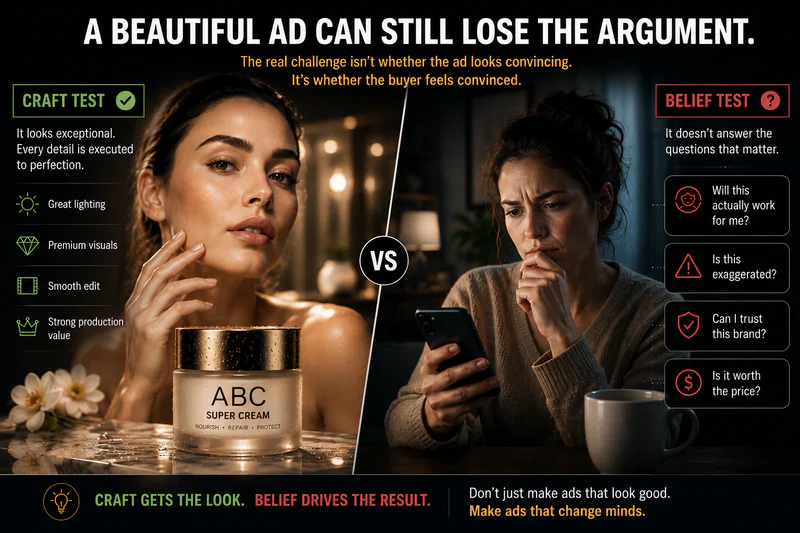
Some AI ads fail loudly. The face looks odd, the hands are wrong, the voice feels fake, and everyone knows what happened. The harder ads to judge are the ones that look good. The product is sharp. The camera moves well. The scenes feel expensive. The AI has done enough to make the ad look great. But once the campaign runs, nothing much happens. People watch for a second, scroll past, and forget the brand. The ad had no pull. This is one of the central challenges in using AI ads. In this article, we will cover why AI ads underperform, why story logic matters before AI ad production, and how brand directors can review AI ad concepts before putting budget behind them.
The Visual Standard Rose. The Emotional Standard Rose Too.
The problem with AI ads is not always that they look artificial. Many do not. The problem is that they pass the wrong test. In a review room, AI visuals can make an ad feel more resolved than it is. The lighting is handled. The product has a presence. The scene has movement. The team starts discussing taste, such as color, pacing, realism, and music, before anyone has tested whether the ad changes what the viewer believes, feels, or does next.
That is where good-looking AI ads leak performance.
The ad passes the craft test but fails the belief test. A skincare ad can show flawless AI-generated skin and still avoid the buyer’s real hesitation: “Will this work on skin like mine?” “Is this claim exaggerated?” “Will this irritate me?” If the ad does not deal with that hesitation, beauty becomes avoidance.
The edit hides weakness instead of building conviction. Fast cuts can help on social platforms when they create pace and momentum. They become a problem when they hide what the ad cannot hold: a face, a hand, product texture, a real use moment, or a believable emotional beat. The ad feels energetic, but the viewer never gets enough proof to trust it.
The human moment has no behavioral truth. A financial app ad with an AI couple smiling at a laptop looks acceptable. The more revealing moment is quieter: someone checks their balance after rent clears, delays a purchase, then opens the app because they need control without another lecture.
The novelty creates attention with no transfer. A tourism ad can animate a painting or historical figure and win the first second. But if the viewer remembers the device more than the destination, the ad has spent attention without transferring value to the brand.
The voice loses the brand’s useful edges. AI often sands down the tone that makes a brand believable. Streetwear loses bite. B2B loses authority. Luxury loses restraint. D2C loses intimacy. The copy becomes fluent, but the brand becomes less itself.
For brand directors, the review question is not “Does this look good enough to run?” It is: what belief, feeling, or action does this ad make easier to change?
Why AI Ads Need Creative Friction Before Production
Creative friction is the uncomfortable part of making an ad better. It is the moment someone stops the room from approving a good-looking asset too quickly. The ad may look great, but someone still asks: what is this making the buyer believe? What will they understand in the first few seconds? What hesitation does this remove? What action does this make easier?
That is creative friction. It is not endless feedback or personal taste. It is not “I like it” versus “I do not like it.” It is pressure-testing the ad before production quality makes weak decisions harder to see. In AI ad production, this matters even more because the draft can look advanced before the thinking has been challenged. The team may start fixing details such as color, music, camera movement, and realism while the bigger commercial questions remain untouched.
Creative friction means challenging the ad in four ways:
1. Challenge the audience assumption.
Who is this really for, and what are they already worried about? A B2B software ad aimed at operations leaders should not settle for “save time.” The sharper tension might be that manual reporting keeps creating errors before leadership meetings, and nobody wants to defend another messy dashboard.
2. Challenge the first few seconds.
Does the opening create a reason to stay, or does it only look attractive? A luxury hotel ad may show a perfect ocean view, but if the goal is direct bookings, the opening may need to address a more practical tension: the viewer wants a weekend escape, but every hotel looks the same and the booking sites make the decision feel risky.
3. Challenge the product’s role.
Is the product changing the buyer’s situation, or is it just present in the ad? An electric toothbrush should not only rotate in beautiful lighting. The ad should show why the buyer might rethink their current habit, such as realizing that “good enough brushing” may not feel so good after the next dentist visit.
4. Challenge what should be removed.
AI makes it easy to add more scenes, more motion, more effects, and more variations. Creative friction asks what deserves to be cut. A sneaker ad about commuter comfort may not need a dramatic AI cityscape. It may need the crowded train platform, the long walk home, and the small relief of not thinking about your feet.
Creative friction protects the ad from becoming easy to approve and expensive to run. It gives the team a way to judge whether the creative can create attention, clarity, trust, or action before media spend exposes the weakness.
What Makes An AI Ad Worth Caring About
People care when an ad gives them one of four things quickly: recognition, tension, proof, or desire. It does not always need a full story arc. A sharp product demo, a familiar problem, a credible before-and-after, a status cue, or a well-timed line can do the job.
Many generative AI ads miss this because they optimize for visual finish before they create a buying reason.
A running shoe ad can make people care without a dramatic athlete story. It can show one ordinary moment: a runner coming down the stairs the morning after a short run and noticing their knees again. That is enough. The viewer understands the problem before the product appears.
A meal-kit ad can make people care without a family dinner montage. It can show 6:45 p.m., an open fridge, a tired person checking delivery apps, and the small resentment of having to decide dinner again. The care comes from recognition.
A shampoo ad can make people care without fantasy hair. It can show someone checking their roots before leaving, realizing their hair already feels flat, and deciding whether to change the way they wear it. The product has a job because the moment is familiar.
A B2B software ad can make people care without a big transformation story. It can show an operations lead fixing a reporting error ten minutes before a leadership meeting. The tension is not cinematic. It is specific, commercial, and embarrassing enough to feel real.
The creative test is simple: Does the ad create recognition, tension, proof, or desire before it asks for attention? If not, it only makes the weak spot harder to see.
Conclusion
AI ads fail when the work becomes easier to approve than to believe. The danger is not that every AI ad looks fake. The sharper danger is that many now look good enough to hide a weak commercial argument. The edit has pace, the product has presence, the visuals feel premium, but the viewer still does not feel recognition, tension, proof, or desire.
That is why story logic matters before production. Not because every ad needs a dramatic plot, but because every ad needs a persuasive job. It has to change something: a belief, a feeling, a hesitation, a memory, or a next action. Before putting media behind an AI ad, brand directors should ask one uncomfortable question: If we removed the polish, would the idea still make someone care? If the answer is unclear, the ad is not ready for budget.
That is why we believe that as an AI Film Studio working on brand video production and premium AI ads, Personate's job is to keep the story logic visible before the film leaves the room.
Want a second opinion before your AI ad goes live? Reach out to review your AI ad concept, sharpen the story logic, and turn polished visuals into campaign-ready creative. You can find us by emailing us at hello@personate.ai, or you can get in touch using this form or by booking a call.
Also read,
https://personate.ai/blog/what-studio-grade-really-means-in-ai-video-for-brands
https://personate.ai/blog/brand-video-production-in-72-hours-personate-6-step-process