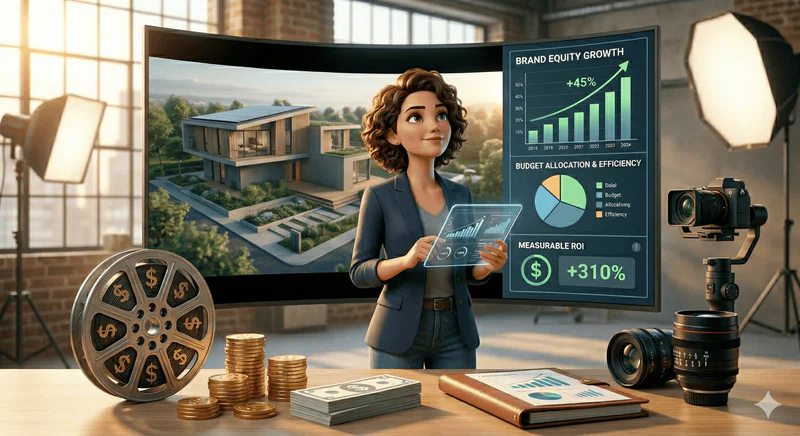
Most brand films are priced wrong before shooting starts. The production budget gets scrutinized; the full cost system rarely does. Brand films live and die on digital video channels, and digital video is one of the fastest-growing ad channels in the world. More formats, more platforms, and more versions are required just to distribute a single asset. Yet marketing budgets have not kept pace with that demand. Every campaign that resets from scratch pays the full setup cost again: new creative, new production, new distribution logic. Brand storytelling video built for one flight and retired after it is an expensive habit in a tight-budget environment. The question is not whether to invest in brand films. It is whether the production model behind them is built to compound or expire. AI video ads have changed what is possible at the adaptation and versioning layer. What has not changed is the cost of getting the creative layer wrong.
TL;DR
The economics of brand films are misread because most teams measure against production cost alone. The full cost system includes distribution, measurement, and compliance, and those layers often exceed the shoot budget. Every campaign that resets from scratch pays the full stack again. AI video ads change that equation by collapsing the marginal cost of versioning and adaptation, but the savings only hold when creative direction governs what the system generates. Without it, the cost does not disappear; it moves downstream into corrections, rework, and eroded brand equity. The production model that improves brand film economics over time is not the one that automates the most. It is the one built to compound.
Brand Films Have Four Cost Layers. Most Teams Budget for One.
Most brand film budgets cover the shoot. The other three layers get discovered later, usually when someone is already overspent:
Production: script, shoot days, editing, and post-production
Distribution: paid media, platform versions, aspect ratio cuts, and trafficking
Measurement: brand lift studies, sales lift tests, and marketing mix modeling
Compliance: rights clearances, legal approvals, and synthetic media labeling
Each layer adds real cost. A film that looks affordable at the production stage can become expensive once the other three are added up.
This matters because brands are not buying video anymore; they are buying outcomes. A 2024 IAB buy-side report found that business outcomes are the top KPI across social video, online video, and connected TV buyers. A brand film that requires expensive recutting, complex localization, and a separate measurement program on top of production is not a lean investment, whatever it cost to shoot.
How AI Video Ads Change the Cost Structure
AI does not make brand films cheaper to conceive. It makes them cheaper to adapt, version, and distribute after the core idea is locked. That distinction matters, because the economic case for AI video ads collapses the moment it is overstated.
The pressure brands are already under
Gartner's 2025 CMO survey found marketing budgets have flatlined at 7.7 percent of company revenue. At the same time, AICP's 2026 bid reference guide treats the following as standard scope on every modern production:
Varied aspect ratios and vertical deliverables
Rapid post schedules with multiple cutdown lengths
Full platform deliverable sets across surfaces
Brands are being asked to produce more formats, more versions, and more market adaptations from the same budget envelope. That gap is where AI creates its clearest economic leverage.
Where AI compresses cost most efficiently
Post-production and localization are historically the most labor-intensive stages after the shoot. Each of the following previously required separate production cycles:
Cutdowns and length variants
Aspect ratio conversions from 16:9 to 9:16 to 1:1
Subtitle generation and voiceover adaptation
Regional compliance cuts for different markets
AI-assisted workflows collapse cycle time across all of them, reducing the marginal cost of every additional variant. Video commercial production runs at billions of dollars, a meaningful share sits in exactly this kind of versioning and adaptation work.
What AI does not change
A system generating cheaply from a poorly defined brief produces more of the wrong thing faster. The savings at the adaptation layer only hold if the creative direction layer above it is doing its job.
Why AI Alone Produces the Wrong Outcome
The cost savings AI creates at the adaptation layer are real. The risk is assuming those savings hold regardless of what is feeding the system. They do not.
The output problem
AI generates at the speed of instruction. When the instruction is vague, the output is generic. When the brand brief is loosely defined, AI-assisted production does not compensate for that; it scales it. A poorly defined creative foundation produces inconsistent tone across cutdowns, weak brand differentiation across markets, and assets that require expensive manual fixes before they can be distributed. That corrective rework eliminates the savings that justified the AI workflow in the first place.
The audience trust problem
There is a second layer of risk that sits closer to the audience. The Interactive Advertising Bureau's "AI Ad Gap Widens" research, conducted with Sonata Insights, found:
39 percent of Gen Z consumers feel negatively toward AI-generated ads
20 percent consumers describe brands using AI as manipulative
16 percent consumers call the practice unethical
The perception gap between ad executives and young consumers widened from 32 points in 2024 to 37 points in 2026
Brand-side marketers tend to overestimate how positively audiences receive AI-generated content. The gap between what executives assume and what audiences actually feel is not narrowing; it is growing.
The counterintuitive finding on disclosure
The same IAB research found that 73 percent of Gen Z and Millennial consumers say clear disclosure of AI use would either increase or have no negative impact on their likelihood to purchase. Transparency about how AI video ads are made is not a liability. It is a trust mechanism, and it changes how those assets land with the audiences that matter most.
The problem is not AI. It is AI without a control layer that governs what gets made, what gets approved, and what gets disclosed. That control layer is creative direction.
Creative Direction Is an Economic Control Layer, Not a Creative Preference
Most brand teams think of creative direction as the part of production that governs how the work looks and feels. That framing is not wrong, but it is incomplete. In an AI-assisted production system, creative direction is the mechanism that determines whether lower-cost output stays valuable or becomes expensive to fix.
What breaks without creative direction
What AI cannot do is self-correct against a brand standard it has not been given. When creative direction is absent or applied too late, four failure modes appear consistently:
Tone drift: Platform variants produced without a locked tone brief feel like they were made by different teams. The audience stops recognizing the brand across touchpoints. The fix is manual re-editing, which costs more than the original version saved.
Product fidelity erosion: AI-assisted localization flattens the specific visual and verbal codes that make a brand distinctive. Color treatment shifts. Product framing loses precision. Individually, none of these feel significant; cumulatively, across different markets, the brand in the final asset no longer matches the brand in the hero film.
Generic output: AI systems trained on broad creative datasets trend toward the average of what has performed before. Without strong creative constraints, brand storytelling video looks competent and feels familiar, which is a precise description of content that does not build distinctive memory.
Disclosure gaps: The disclosure for synthetic humans, AI-generated voices, and virtual characters cannot be an afterthought anymore. Without creative direction governing this from the start, disclosure becomes reactive rather than designed into the asset.
The cost of fixing problems downstream
Each failure mode is recoverable in isolation. The economic problem is that they tend to appear together, and fixing them at the distribution stage costs substantially more than preventing them at the creative stage.
For example: A brand that saves approximately 40 percent on versioning through AI and spends 60 percent of that saving on corrections has not improved its cost structure. It has moved the spend to a less visible line item.
Why this compounds over time
The longer-term cost is harder to quantify but more consequential. The Institute of Practitioners in Advertising's long-run effectiveness research shows that emotional consistency in brand communication builds memory structures that translate into pricing power and reduced price sensitivity over time. Those outcomes depend on the same creative codes appearing repeatedly across every asset and every format. Creative direction is what keeps those codes intact as production volume scales. Every asset generated without that governance slightly degrades the brand's long-term equity, and that degradation is invisible until it shows up in pricing data or competitive share months later.
The reframe that matters
Creative direction is not an additional cost to AI-assisted production. It protects the return on every asset the system generates. Brands that treat it as overhead to be minimized end up with large volumes of inexpensive assets they cannot confidently put in the market. Brands that build it as a control system before generation begins are the ones that scale without losing the brand value the production was meant to build.
The Production Model That Builds on Itself
Brand film economics only improve when the production model behind them is built to compound. That means planning for all four cost layers upfront, applying AI where it creates real leverage, and keeping creative direction governing everything the system generates. Without that structure, lower-cost production does not solve the problem. It relocates it.
Personate is built around that logic. The production process runs in four stages:
Strategy: Audience, positioning, and campaign narrative defined before a single asset is generated
Approval: Scripts and concepts aligned and signed off before entering the production queue
AI Production: AI video ads generated with studio-level oversight, refined against the brief until the output is right
Optimization: Campaigns evolve through structured performance feedback rather than being retired after a single flight
Each stage feeds the next. Strategy sharpens the brief. Approval catches misalignment before it scales into expensive rework. Production generates with precision rather than volume. Optimization turns each campaign into a learning asset that makes the next one faster and cheaper to build. The brands that get the most from this model are not the ones spending the most. They are the ones that stopped resetting and started compounding.
The difference between AI that makes production cheaper and AI that makes brand films worth more is the system behind it. That is what Personate is built to be.
Ready to see what that looks like for your next campaign? Reach out at hello@personate.ai.
Also read,
Why Brand Films Beat Content Spam in a World Flooded by AI
About the author:
Akshay Sharma is the CEO of Personate.ai and launched the world’s first virtual AI TV anchor in 2023 . He writes about AI advertising, brand films, and building trust in an AI-driven media landscape.