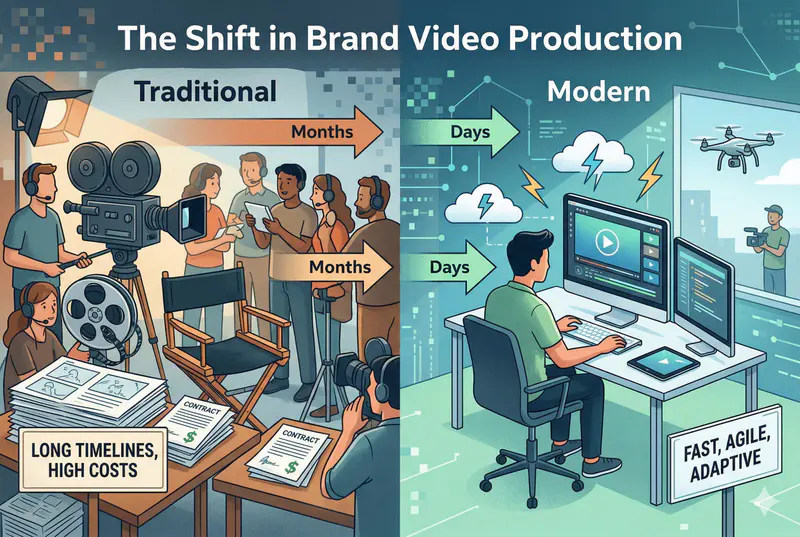
Creating a strong brand video has traditionally meant long timelines, complex coordination, and high production costs. That model no longer fits the pace at which modern brands need to launch campaigns and respond to market shifts. As demand for faster content grows, so does the need for a production process that can move quickly without lowering creative standards. Personate addresses that gap by combining AI production with human oversight to deliver brand videos in 72 hours.
The Process That Makes Personate's 72-Hour Video Production Possible
Fast video production only works when the workflow is clearly defined from the start. Personate follows a six-step process that moves from concept brief to final delivery in a focused and efficient way. Instead of stretching production across multiple handoffs, the team uses AI to accelerate scene creation and editing to refine the final output. That combination helps shorten timelines while keeping the video aligned with the brand.
Step 1: Concept Brief
Personate begins with a concept brief that captures the goal of the video, the overall concept or script, and the campaign context behind it. This step gives the team the inputs needed to understand what the video should communicate before moving into storyboard development.
At this stage, brands can share:
product or service details
target audience
key messaging
brand guidelines
visual references
past campaign assets
a rough script or concept note
The more specific the brief, the easier it is to shape the next stage around a clear objective. Instead of starting with assumptions, Personate starts with direction that reflects the brand, the message, and the intended outcome.
Step 2: Concept Crafting in 24 hours
Personate translates the brief into a structured storyboard within 24 hours. This step defines how the video will flow, what each scene will communicate, and how the narrative will build from start to finish.
The team uses the inputs from the brief to map out:
scene-by-scene breakdown
visual direction and transitions
on-screen text or voiceover cues
pacing and narrative structure
This is where the video starts to take shape as a brand storytelling video, not just a sequence of visuals. By locking the storyboard early, Personate creates a clear blueprint for production, which reduces revisions later and keeps the 72-hour timeline on track.
Step 3: AI Production Layer
Personate moves from planning to production by generating custom scenes based on the approved storyboard. Instead of relying on stock footage, fixed templates, or a traditional shoot, this step uses AI to create visuals that match the concept, tone, and structure defined earlier.
At this stage, the production layer focuses on:
scene generation based on the storyboard
visual consistency across scenes
alignment with brand style and references
faster asset creation without full-scale production logistics
This is the stage that compresses the timeline. By generating scenes digitally, Personate can move from concept to visual output much faster than a conventional production process while still building around the narrative approved in the storyboard. That makes speed possible without disconnecting the visuals from the original idea.
Step 4: Human-led Creative Judgment, Taste, and Polish (Pacing, Storytelling, and Realism)
Personate refines the AI-generated scenes through human-led creative judgment and taste to improve pacing, storytelling, and realism. This is the stage where the video is shaped into a more cohesive final asset rather than a sequence of generated visuals.
At this stage, the team focuses on:
tightening scene flow and pacing
improving narrative continuity
refining transitions and timing
polishing details that affect realism and overall finish
This human layer is what helps the final video feel more deliberate and brand-ready. AI can speed up production, but editing is what gives the output control and finish before the first draft is shared.
Step 5: First Draft Ready (Within 48 Hours of Storyboard Approval)
Personate shares the first video draft within 48 hours of storyboard finalization. By this stage, the concept has been defined, the scenes have been generated, and the edit has been shaped into a version the brand can review against the original brief.
From the brand side, this is the stage to review:
overall flow and structure
scene selection and visual direction
pacing and storytelling
messaging alignment
any changes needed before final delivery
The most useful feedback at this point is clear and specific. Instead of revisiting the whole concept, brands can focus on what needs refinement in the draft itself, whether that is a scene, a line, a transition, or the pacing of the edit. That makes it easier to move into revisions without slowing down the process.
Step 6: Feedback and Revisions
Personate refines the first draft based on brand feedback and prepares the video for final delivery. At this stage, the focus is on improving specific parts of the edit rather than revisiting the concept from the beginning.
Revisions may include:
scene-level adjustments
messaging updates
pacing improvements
visual refinements for better consistency
This step works best when feedback is clear and prioritized. Focused comments help the team make effective revisions quickly, which keeps the process moving toward a final version that is ready to publish.
Why Personate’s 72-Hour Timeline For AI Brand Video Matters
A 72-hour turnaround does more than speed up production. It changes whether video is useful in the first place. In many teams, the problem is not the lack of ideas. It is the delay between identifying an opportunity and getting an asset ready to ship. Traditional production often breaks that window. By the time the video is approved, the launch has moved on, the campaign has shifted, or the team has already compromised with a weaker asset.
The 72-hour model solves for:
Campaign timing: Video becomes easier to use when it can match the pace of launch cycles, product drops, and active campaigns. A shorter turnaround helps brands respond while the moment is still relevant, not after it has passed.
Approval drag: In many workflows, time is lost between stages, not inside them. Briefing stalls, concepts sit in review, and production cannot move until everyone aligns. Personate reduces that drag by moving quickly from brief to storyboard, then from storyboard to draft.
Late visibility: Brands often wait too long to see something concrete. That creates risk, because major issues surface late, when changes are harder to make. A fast first draft brings visibility earlier, which gives teams more control over the final result.
Production overhead: Traditional video timelines are often shaped by logistics such as shoots, schedules, locations, and resourcing. Personate removes much of that delay by generating scenes digitally from an approved creative direction.
Momentum loss: Long production cycles weaken decision-making. Stakeholders revisit earlier choices, priorities shift, and the original brief starts to blur. A compressed timeline keeps the project close to the initial objective and makes feedback easier to ground in the actual draft.
Usability of the final asset: Fast only matters if the output is still ready to use. The value of 72 hours is not just speed. It is the ability to get a polished video inside a working campaign window, while there is still time to publish, test, adapt, or scale it.
At a deeper level, this is what the timeline changes: video stops being a slow creative project that teams work around and becomes a content format they can actually plan around.
About the author:
Akshay Sharma is the CEO of Personate.ai and launched the world’s first virtual AI TV anchor in 2023 . He writes about AI advertising, brand films, and building trust in an AI-driven media landscape.
Also read,
Brand Film Economics: The Case for AI Video Ads Under Creative Direction | Personate
How to Use Your Personate Credits Strategically: A beginner's Guide | Personate